Protect the Diaoyutai Movement
保釣運動
Source: The Eruption and Impact of the Baodiao Movement
From: A Review of Postwar Taiwanese Student Movements
Date: October 12, 2015
Author: Tang Chih-chieh
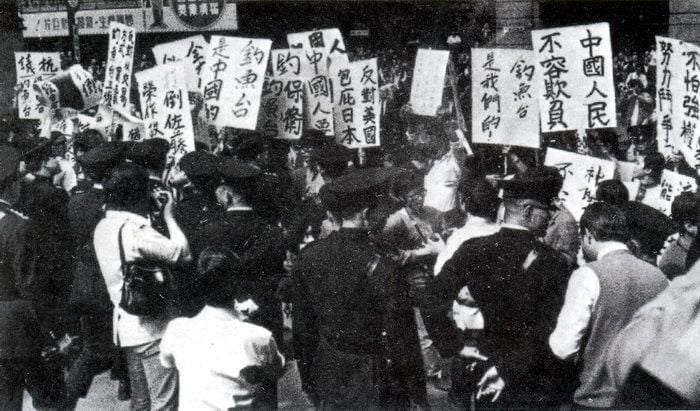
On September 10, 1970, the United States and Japan agreed that the US would transfer administrative control of the Ryukyu Islands — occupied since World War II — to Japan in 1972. Since both countries considered the Diaoyu Islands (known in Japanese as the Senkaku Islands) to be part of the Ryukyus, a movement arose among students at home and abroad to defend Taiwan’s territorial claim to the islands. The Diaoyu Islands transformed from little-known uninhabited rocks into disputed territory coveted by all parties — a development largely triggered by a 1968 UN ECAFE study suggesting that the seabed around the islands contained rich oil reserves. In late 1970, Taiwanese and Hong Kong students studying in the United States began to coordinate, staging protests to protect the Diaoyu Islands in various cities. The experience of the Baodiao (Protect Diaoyutai) Movement not only fostered connections among students, but further galvanized student movements demanding freedom of speech and campus democracy.
External Links
- Baodiao Movement (Wikipedia)
- Commemorating the 40th Anniversary of Baodiao: The Precious Legacy of the 1970s Movement (Labor Notes Taiwan)
- History of the Hong Kong Baodiao Movement (InMedia HK)
- Retrospect and Reflection on the Baodiao Movement (Wu San-lien Taiwan Historical Materials Foundation)
- Lin Hsiao-hsin: From Baodiao to Taiwan’s Democratization — An Anachronist (The Initium)
- BBC Feature: The Complex Entanglements of Taiwan’s Baodiao Movement (BBC Chinese)