Venice Biennale Taiwan Pavilion Focuses on ‘Sounds of Taiwanese Society’
威尼斯雙年展台灣館以「台灣社會聲響」為主題
Source: 54th Venice Biennale Taiwan Pavilion
From: Taipei Fine Arts Museum
Date: June 4, 2011
“Hearing, and the Unheard: Taiwan’s Social Soundscape” is an exhibition about “sound” that maps Taiwan’s social soundscape. “Sound” is the core theme, carrying multiple meanings — it functions simultaneously as content and form, and as a metaphor for the political field of action in contemporary society. The exhibition explores the ways in which different “individuals” or “groups” within society assert their existence. Through the political energy of “sound” and the “difference” it represents, the exhibition opens inquiries into community consciousness, the emergence of social movements, and the formation of cultural forms. On one hand it outlines the relationship between social sound and its era; on the other it explores how sound is heard and what its political and social dimensions are.
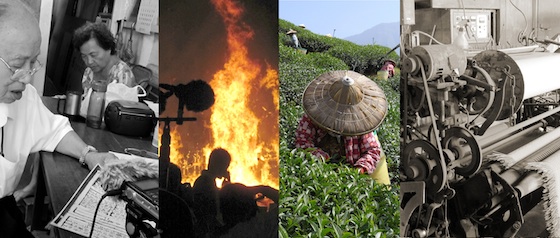
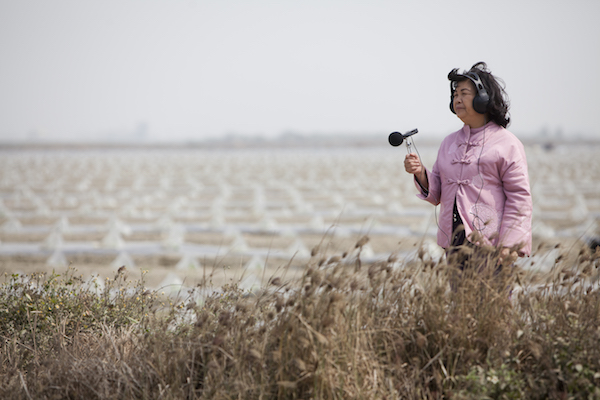
Wang Hong-kai’s work “Our Workers’ March” takes “sound” as its primary medium and concept. She holds that “listening is political.” Her earlier practice focused on environmental listening; in recent years she has shifted toward an “organization of listening” — a conscious observation, processing, use, and exploration of ordinary perceptual experience. In “Our Workers’ March,” she goes beyond subjective documentation and sound collection to explore Taiwan’s history and social space through collective “recording.” Wang returned to her hometown of Huwei in Yunlin to collaborate with a sugar factory that has operated for over a century, inviting retired workers and their family members back to the factory. Through a series of sound workshops, she placed microphones in the hands of the retirees and their families, allowing them to actively record the sounds of their former working and living environments.
Su Yu-hsien’s work “Sounds of Not Much” is a project focused on ordinary people. He ventures into the lower strata of society to re-examine people leading different yet unremarkable lives — rag pickers, foreign sailors, vagrants. Su invites them to form bands and make “music,” producing albums and documents in the manner of independent bands, releasing amateur albums on behalf of these social individuals or groups as a channel for their voices. These “bands” are a metaphor for the “voices of difference” within society; their untrained music asserts the existence of individuals. Su says this is “letting them speak and sing about sounds that are near us yet strangely distant.”
The exhibition venue will include a planned “Sound Archive / Bar” that uses audio-visual materials to sketch Taiwan’s historical transitions and social contexts. Audiences can enter this relaxed public space and experience Taiwan’s social fabric through viewing and listening. Cultural commentators Chang Tieh-chih and Lo Yueh-chuan, together with architect Liu Kuo-tsang, organized and designed this Sound Archive / Bar. It traces the sounds of social movements and sound creation in Taiwan from the lifting of martial law (1987–) to the present, featuring more than a dozen “sound events and records” that have driven change in Taiwanese society. Additionally, Taiwan sound artists and performance artists Wang Fu-jui, Lin Chi-wei, and DJ @llen will perform live during the opening period.
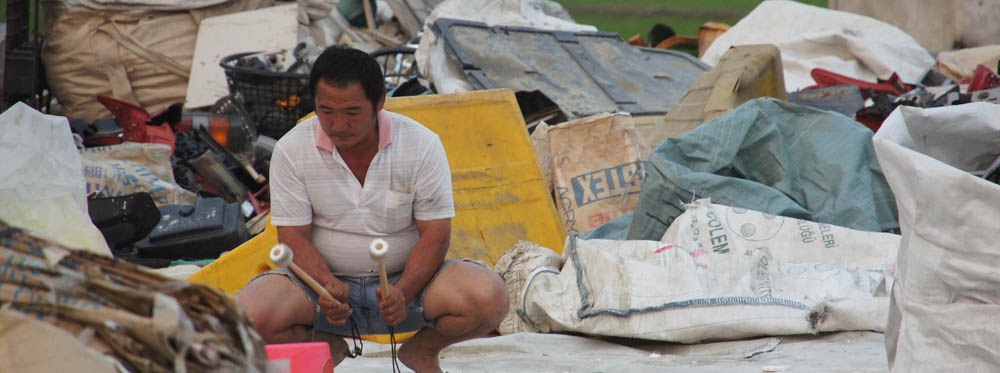 Su Yu-hsien’s “Sounds of Not Much: Plastic Man Band” (provided by Taipei Fine Arts Museum)
External Links
- The Composer Wrote the Future, So as to Leave Behind What the Future Would Not (TheCube Project Space)
- No Drugs, No Sex, But Closer to Rock Than Anything — Su Yu-hsien and the Sound Art of Amateurs (Yu Wei)
- Wang Hong-kai on Recent Sound Works (ARTFORUM)
- The Multitude’s Voice Is *Noise Magazine* — “Hearing, and the Unheard: Taiwan’s Social Soundscape” in Venice (Lin Hung-chang)