Formosa Incident (Kaohsiung Incident)
美麗島事件
Source: Formosa Incident
From: Kaohsiung — Formosa Incident, compiled by Lee Mu-hui
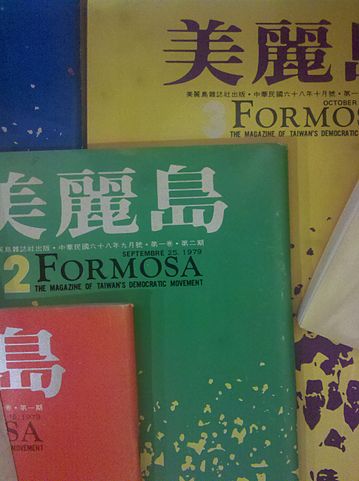
In August 1975, Taiwan Political Review was founded, declaring its intent to carry on the tradition of Free China and University Magazine in “building a platform for public opinion.” In the five concurrent local government elections of late 1977, the “outside the party” (tangwai) candidates achieved unprecedented success, greatly emboldening the movement and leading to gradual organization. In the summer of 1979, tangwai figures Huang Hsin-chieh and others founded Formosa (Mei-li-tao) magazine. That same year, Taiwan was shaken by an incident — the “Formosa Incident” — that astonished people at home and abroad: on December 10, in Kaohsiung, over twenty thousand people gathered to celebrate the 31st anniversary of the United Nations’ Declaration of Human Rights; what began as a rally for freedom of expression escalated into a standoff between police and demonstrators.
On November 30, 1979, Chen Chu and Chou Ping-te applied to the Kaohsiung First Precinct — which had jurisdiction over the Formosa Kaohsiung service center — to hold a Human Rights Day rally from 6 PM to 11 PM on December 10 at the Rotary Plaza across from the Tatung Department Store. After several unsuccessful attempts to obtain approval, they decided to proceed with preparations as planned. On December 9, as a Formosa campaign van set out to broadcast news of the rally in Kaohsiung, police formed a human barrier at the entrance to prevent its departure. A physical confrontation ensued; in the chaos, Yao Kuo-chien and Chiu Sheng-hsiung were arrested — this became the “Kushan Incident” and set the fuse for the Formosa Incident. On December 10, Shih Ming-teh, Yao Chia-wen, and others led two or three hundred people in delivering speeches at the central traffic circle on Chungshan First Road; during the proceedings, soldiers, police, and demonstrators clashed at least four times, culminating in riot police being ordered to forcibly disperse the crowd. In the aftermath, virtually all major figures active in the tangwai camp were arrested — an event known as the “Formosa Incident” or the “Kaohsiung Incident.”
This incident wrote a tragic final chapter to the 1970s, and opened a turbulent prelude to the 1980s. It was not only a major watershed in the history of Taiwan’s democracy movement, but also a painful rite of passage in the intellectual transformation of Taiwan’s thinking class.

Tags
External Links
- Formosa Incident (Wikipedia)
- Formosa Incident Theme Archive (Archives Time Capsule)
- Retrospect and Reflection on the Formosa Incident (Taiwan Association of University Professors)
- The Course and Impact of the Formosa Incident (Yidu)
- 1977 Elections and the Chungli Incident: Precious Images of the Formosa Democracy Movement (Part I) (Gushi)
- From Mass Arrest to Military Trial: Precious Images of the Formosa Democracy Movement (Part II) (Gushi)